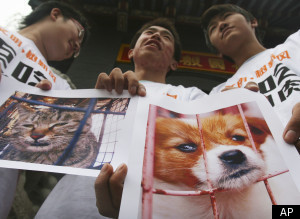
A 600-year-old dog eating festival in Qianxi, China was banned this week after a massive social media outcry called for its cancellation. Fifteen thousand dogs are slaughtered annually at the festival, which commemorates a battle fought in the town. Before the battle, an invading army killed all the dogs in the town of Qianxi to prevent being exposed by barking dogs. After capturing the town, the army ate the dog meat to celebrate.
From then until the '80s, the dogs were killed immediately before being cooked and served. Then the Chinese government intervened and banned on-site butchery. But the practice began to creep back into the festival over the past few years. Pictures of carnage from the dog eating festival made their way on to the internet, incensing thousands. This year, many of them took to the internet to call for the festival to be banned. The Chinese government reacted by banning the festival.
According to Global Post, sympathy for dogs has increased markedly among the Chinese over the past few decades; keeping them as pets was banned during the Cultural Revolution, but rates of ownership have risen since then.
There have been some calls for a total ban on eating cats and dogs in the country, it remains both common and socially acceptable. It's possible, though, that this recent move could signal a further shift in government sentiment towards the side of a ban; rumors of such a ban started to escalate as early as June.
Malcolm Brenner, 60, wrote "Wet Goddess," a new book about a man's nine-month sexual relationship with a dolphin -- an affair that bears "a striking degree of resemblance" to his own interspecies romance.
The author claims he started his relationship with a dolphin named Dolly back in 1970, when he was in his early 20s. Brenner was a sophomore at New College of Florida in Sarasota. A writer hired Brenner to take photographs for a children's book about the dolphin show at an amusement park in nearby Nokomis. He was given free access to the park and introduced to the staff.
If Brenner is to be believed, the dolphin courted him.
Initially, "she became more and more aggressive," said Brenner, who lives in Punta Gorda, Fla. "She would thrust herself against me."
But over time, Dolly became more gentle, he claimed.
"I found that extraordinarily erotic," Brenner said. "It's like being with a tiger or a bear. This is an animal that could kill you in two seconds if it wanted to."
After about nine months, the Floridaland amusement park was sold to become housing.
His college sweetheart was shipped off to an oceanarium in Gulfport, Miss., while he said he enrolled in Evergreen State College in Washington.
The Huffington Post has been unable to verify his account of the affair with Floridaland officials; the park closed in 1971. However, historical photos and archival brochures indicate there was a "Porpoise Pool" attraction at Floridaland.
"I had every intention of going to visit the dolphin when I got back to the South, but it didn't work out that way," Brenner said. "I learned the hard way that dolphins are chattel, and much more emotionally vulnerable than I had ever imagined."
Brenner said Dolly died about nine months after the last time he saw her.
"I had a vivid dream at the time about dolphins dying in a dark environment which proved to be remarkably similar to the oceanarium where she actually died," Brenner said.
"Glorifying human sexual interactions with other species is inappropriate for the health and well being of any animal," Herzing told HuffPost. "It puts the dolphin's own health and social behavioral settings at risk."
But Brenner insists his relationship did not harm the dolphin.
"Some people find it hard to imagine that I wasn't abusing the animal," Brenner said. "They didn't see me interacting with the dolphin. They weren't there. These creatures basically have free will."
Brenner points out that some researchers have argued dolphins should be considered "non-human persons," because of their intelligence.
"What is repulsive about a relationship where both partners feel and express love for each other?" Brenner asked. "I know what I'm talking about here because after we made love, the dolphin put her snout on my shoulder, embraced me with her flippers and we stared into each others' eyes for about a minute."
"This was not some dog trying to hump my leg, okay. This was a 400-lb. wild-born female dolphin. She was an awesome creature."
"As self-aware mammals, dolphins are capable of making profound emotional attachments to other dolphins and, apparently, to selected humans as well," Brenner said. "A dolphin can die of loneliness, of a broken heart, of separation anxiety."
As evidence of his claims, Brenner points to the story of former trainer turned animal rights activist Richard O'Barry, who said he watched a dolphin living in captivity commit suicide in his arms.
He's not married, but Brenner said he has two ex-wives who knew about his fling with Dolly.
"Neither one objected," Brenner said.
His daughter from his first marriage even designed the book cover.
Brenner, who is now a freelance writer and photographer, started writing "Wet Goddess" in 1973 at the suggestion of Dr. John C. Lilly. Excerpts were published in the 1974 anthology "Mind In The Waters" and Penthouse, according to Brenner.
"I was still too emotionally raw from the experience and my writing skills were inadequate to the task," Brenner said.
He took it up again in 1994, finished the novel in 2000 and spent the next 10 years trying to get it published. Brenner said he shopped it around, but after "mainstream" publishers rejected "Wet Goddess," he decided to self-publish the book last year.
So far he has sold about 230 paperback copies and 20 e-books. Vendors sell it for $16.95 on Amazon.
"I wrote this book for dolphins because we are mistreating these animals by keeping them in captivity," Brenner said. "We should be attempting to communicate with them and treating them with more respect and dignity."
Brenner said he might consider another relationship with a dolphin in the future.
"Under the right circumstances I would if I had the energy for it," Brenner said. "I'm 40 years older now."
The Internet has effected media in a huge way. This is a very important topic because the Internet has effected media by forcing all the different outlets to prove their relevance. If they fail to prove their relevance they face extinction to new and emerging technologies.
All media is at risk, Television and Movie studios, News Papers, Book Publishers, Magazines, the Music Industry, Radio Stations, and even Phone Companies have to constantly compete with the Internet. I believe all this competition exist for two reasons lack of time and money. People are very busy these days, those that have a job are really doing work that should be divided between two or three people. Those that do not work outside the home are working full time in their households or they're working full time looking for full time work, and in this economy everyone is or should be trying to save money no matter which side of the line they stand on.
When it comes to the consumer to major media sources like Television and Movie studios, News Papers, Magazines, and Radio Stations, many find themselves to busy to stick to the schedules these different media outlets provide. Many people like to watch their favorite TV show or movie, read their favorite News Paper, Book or Magazine and even listen to their favorite songs or radio show live on the Internet or catch the podcast later on their own schedule. This is a huge set back for the media as a whole, because it is impossible to provide this type of a service without the Internet. Another huge set back is the fact that people want to receive their favorite type of media on their own terms for free. If these different media outlets don't figure out how to accomplish this they may lose a big number of consumers to new and emerging technologies (technologies that use the internet of course). Phone Companies face stiff competition from new online services like Vonage that offer comparable telephone service for half the price, so these companies have to come up with better plans or they too may be facing some hard times.
Of all the different media outlets, it seems the Music Industry and Book Publishers have taken the biggest hit when it comes to defending themselves against the Internet. The Internet has changed the way people receive and listen to both books and music. These days more and more are moving to eBooks or books that can be read on their handheld devices like a Kindle, Ipad, Ipod, or smart phone. People have purchased CD's for a long period of time, but when the Internet became popular someone figured out how to share the music they had purchased which was great right??? This is what everyone thought, but no one could imagine what this would do to the Music Industry. If music sharing didn't become so popular I don't believe the Music Industry would have taken such drastic steps to punish the few that have been caught sharing their music. People think that just because they have purchased the CD that it is theirs but it is not. The music on that CD has an owner, and that owner is the only one who has the right to either share or charge for their music. Because file sharing has almost destroyed an entire industry I believe the Internet has had the largest (negative) effect on the Music Industry.
The Internet has forever changed the way we communicate with one another. It has opened up the world so someone in the U.S. can communicate with someone in Japan without having a phone line or the other person’s address. This is the main reason the Internet became so popular, but in the process the Internet has virtually cut off physical time spent with other friends and family, because it’s just too easy to send a quick email. It is said that with the growth of technology the American population has become increasingly lazy (for lack of a better word). People have all kinds of reasons for not wanting to call a loved one…maybe they don’t have the time or they feel the person may talk too much? Many will often choose to email or text close friends and family members, because they feel they can “multitask” and do other things at the same time. I believe email and the Internet in general has pushed us all away from friends and family, because it's just easier to send a quick email, Facebook message or Twit pic. When communicating with friends and family members who live across the country I feel Skype is a great option because it’s free, but Skype too is often abused and used for the wrong reasons.
Most Internet friendships are as cheap as they get, most of these so called friends are only your friends because of work, school or another friend. Who truly has two to five hundred friends? Often times these “friends” only want to poke around your page, and may have no real interest in who you are as a person.
While at work I have never had the experience of receiving a forwarded email from a colleague that was meant to be private; but in the past I have noticed people recalling emails they didn't mean to send out. At that point it was too late, the email had already been sent. Often times I would notice the recall email first and after reading it, I can remember feeling an immediate desire to view the original email. Many times the recalled email is what actually brought my attention to the original email.
Facebook Find Reunites Mother and Son After 12 Years
A boy who was only 5 years old when he was taken in 1999 was reunited with his mother on Sunday for the first time in 12 years -- thanks to Facebook.
In 1999, Kattia Liebers was mired in a bitter custody dispute with her husband in her native Costa Rica. And when her husband fled the country, he stole a part of Liebers' life, she told Philadelphia's Fox 29.
"He told me, 'I’m going take your son away from you. I’m going to destroy you,'" Liebers told Fox 29's Chris O'Connell. For years she searched for Jared, unsure where her husband had taken the boy.
"I was crying every day. I couldn't eat, I couldn't sleep," she said.
More than a decade later, the wait is over -- and her life has changed once again. This time, it came by way of a single message on Facebook.
"Hi, is this Kattia Chacon Sanchez by any chance?" the original message asked.
"Who is this?" the mother said she replied.
"I'm Jared Liebers," came the reply.
"If you're Jared Liebers, I'm your mom, and I love you very much," Kattia wrote back.
Jared Liebers had found his mom.
Jared had been living with his father in Israel; on Sunday the 17-year-old moved back to the United States to be with his mother.
Through the years, Kattia kept all of Jared's pictures and toys. And among Jared's current possessions? A book of Spanish words his mother gave him.
Kattia Liebers actually kept her married name so her son would be able to find her after all these years, Fox 29 reported.
Today Jared Liebers is enrolled in North Penn High School in Towamencin Township, Pa. -- and looks forward to catching up on half a lifetime.